Mini-Game Tournament Engine for Real-Time Event Engagement
A robust, backend-authoritative gaming engine handling tens of thousands of concurrent users for live event competitions.
Outcome
Engineered a server-validated, high-concurrency tournament platform that sustained 50,000+ concurrent connections during live broadcast events with zero downtime.
Context
This system was built to power live digital engagements where audiences compete in synchronized mini-games during a broadcast. Unlike asynchronous mobile games, this required all 50,000+ participants to start, play, and finish simultaneously, requiring millisecond-level state synchronization.
Problem
A major event organizer needed a way to run competitive, skill-based mini-games to boost audience retention.
Who needed it: Global brands running large-scale digital campaigns and live streams.
What was missing:
- Massive Concurrency: Ability to handle ~50,000 users connecting within a 30-second window.
- State Integrity: Preventing score manipulation in a high-stakes environment.
- Real-Time Feedback: Instant leaderboards and position updates without database contention.
Solution Comparison
Standard engagement tools (like live polls) handle concurrency well but lack complex logic. Conversely, traditional multiplayer game servers are often stateful and difficult to scale horizontally for tens of thousands of users in a single instance. We needed a hybrid approach: the logic of a game server with the horizontal scalability of a web application.
Solution
I architected a backend-authoritative engine where the server cluster acts as the single source of truth for all game state.
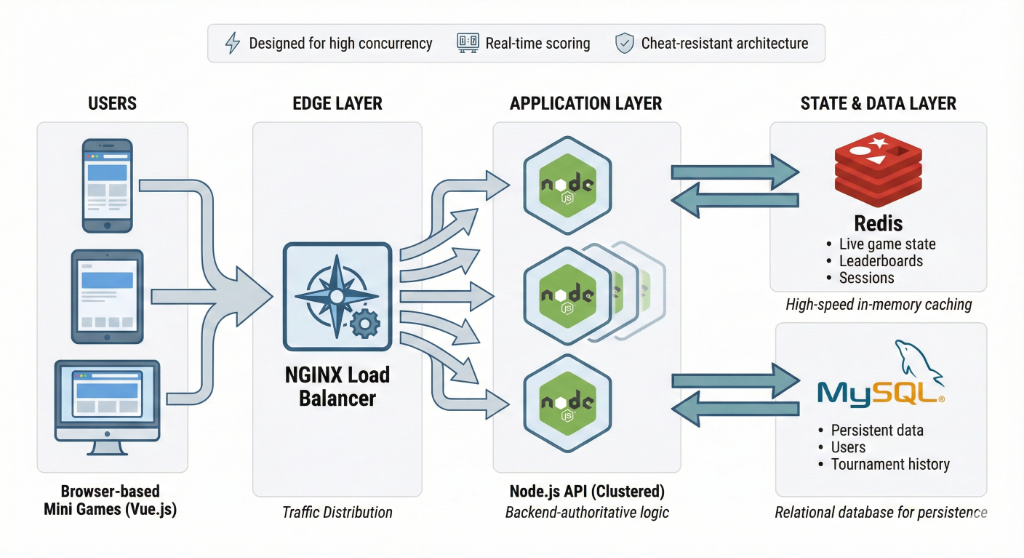
High-Level Architecture
- State Machine: Core game logic runs on clustered Node.js instances.
- Frontend (Vue.js): Acts purely as a renderer and input capture device. It predicts state for responsiveness but rolls back if the server disagrees.
- Edge: NGINX handles SSL termination and load balancing across the node cluster.
- Data Layer: Redis clusters handle ephemeral game state and live leaderboards. MySQL provides durable persistence for user records and final results.
Why this architecture scales
- Stateless logic tier: Game rooms are sharded, allowing us to add Node.js instances horizontally as player count grows.
- Asynchronous persistence: High-velocity game events stays in Redis. MySQL is updated via a write-behind queue, preventing database lockups during gameplay.
- Atomic operations: Redis Sorted Sets and atomic counters manage scoring without race conditions.
What Made It Hard
1. The "Thundering Herd" of Start Times When a host announces "Go", traffic spikes from idle to peak immediately. Solution: We implemented connection jitter and a queuing system at the edge to smooth out the handshake process, preventing the load balancer from rejecting valid connections.
2. Input Validation & Fairness In a browser, the client is untrusted. Solution: The server validates every input frame against physics limits and game rules. If a client reports a score or movement that is mathematically impossible given the time delta, the server rejects it. We calculate the score on the server based on validated inputs, not trusting the client's reported score.
3. Latency & Reconciliation Variable network conditions can cause drift between client and server. Solution: We implemented client-side prediction for immediate visual feedback, coupled with server reconciliation and client correction. If the server's authoritative state differs from the client's prediction beyond a threshold, the client corrects its local state to match the server.
Results
- Scale: Successfully supported ~50,000 concurrent socket connections in a single event environment.
- Reliability: 100% uptime during critical broadcast windows across multiple campaigns.
- Engagement: Partner metrics showed a significant increase in session duration compared to passive viewing events.
Tech Stack
- Node.js: Clustered WebSocket server and game loop.
- Vue.js: Client-side rendering and state prediction.
- Redis: Live state, pub/sub, and leaderboards.
- MySQL: Relational database and historical records.
- NGINX: Load balancing and reverse proxy.
CREDIBILITY
Delivered as part of a paid client engagement.
See my Upwork profile for verified history.
Building a high-scale interactive system?
Let's talk
Building something similar?
I help teams build complex systems that scale. Let's discuss your project.
Get in Touch